TL;DR: The author describes an advanced Positively Focused client who spent a year and a half waiting on a vice president title his company kept withholding. Told to stop chasing it and let the universe handle the details, he did nothing for three weeks. A handwritten card, a selfie and a LinkedIn photo did the rest. Five weeks into the new role, fresh contrast is already showing up.
For a year and a half, my client did the job of a vice president without the title or the salary.
His company kept promising it, then kept moving the date. Meanwhile they handed him the work a VP does, including layoffs across departments he oversees, and none of the designation or money that comes attached.
He got frustrated.
Good. That frustration was doing exactly what frustration is for.
Contrast is how you find out what you want
Most people treat a situation like that as a problem to solve. A better way to see is what we call “contrast” in the Positively Focused practice. Contrast is how you clarify what you want out of what you don’t.
He didn’t want to perform at the VP level while being paid below it, and he didn’t want to keep doing what that company kept asking of him. Both preferences got sharp because the company kept pushing on him. Without the pushing he’d have stayed dissatisfied and hopeful in equal measure, which is where most people live for years at a stretch.
So through the spring, summer and fall, I worked with him on one thing: leaning in the direction of what he wanted.
And I told him what hardly anyone wants to hear: I told him you don’t get to decide how it arrives and you don’t get to decide when it arrives.
Your job, I told him, is to clarify what you want, line up with it and use your positive emotion as the indicator that you’re lined up. That’s the whole assignment. After that, you watch the universe arrange the cooperative components.
He assumed the title would come from his current employer. But I knew better. The contrast he kept generating there was too consistent for that to be the place, so it was going to happen some other way.
The boss who left with a regret
His boss, who I’ll call Marcus, went through his own churn, left the company and took a bigger role at a much larger company.
Before he left, Marcus wrote handwritten thank-you cards to a few people. My client was on the list. Marcus also carried something out the door: real regret that he hadn’t gotten my client promoted before he left. It weighed on him.
A couple of months later Marcus reached out. He wanted my client to come work for him at the new company, at the vice president level. Now, understand what that required: Marcus had signed a non-disclosure and a non-compete on his way out, yet he reached out anyway.
There was no way my client could have engineered or predicted any of that. Meanwhile, he’d been thinking his current employer would deliver what he wanted. Not so.
Marcus got him into interviews to grease the skids, one with the president and one with the CEO. Both went well. Then everything went silent for three and a half weeks.
There was no way my client could have engineered or predicted any of that. Meanwhile, he’d been thinking his current employer would deliver what he wanted. Nope.
The three weeks of doing nothing
This is where the story gets useful to you, reader. In session, my client asked whether he should reach out to Marcus and find out what was happening. Reasonable question. Most people would reach out and call it initiative.
I told him no. Don’t reach out. Let the universe take care of it.
Here’s what took care of it.
The former CTO of my client’s company flew in from California for a high-profile meeting, walked up to him and said he’d been carrying a card from Marcus around for weeks and finally had a chance to hand it over. It was sealed, and he had no idea what was in it.
That same CTO likes taking selfies. He pulled my client into one and announced he was sending it to Marcus, and my client’s first instinct was that the whole thing seemed weird before he went along with it. Marcus replied inside a minute, from Germany, saying something cheeky about taking care of his guys.
That same day my client sat down at lunch beside the incoming CEO of his current company, who remembered him from prior M&A work and greeted him by name. A photo of taken of my client and the CEO reached LinkedIn, because modern executives travel with camera crews now.
That night someone close to him suggested he text Marcus. He said no, because he had a feeling the selfie was going to do a thing on its own. Two hours later a former direct report he hadn’t spoken to in five years messaged him out of nowhere. Why now? Your picture on LinkedIn, the guy told my client.
At 5:48 the next morning, a text from Marcus arrived. “Been a while. Let’s catch up today,” it said.
They talked at 9:30. The delay had been money approval, the title and HR friction over a layoff in a similar configuration. Then Marcus told him those previous conversations had been the interview. Everyone was on board. Open the requisition, apply to it, take a couple of personality assessments, done, Marcus said.
Three and a half weeks of silence, and my client did nothing in any of it while every piece assembled itself. He said it to me in session better than I could: “I couldn’t have forced it if I tried.”
And he’s right. Had he tried to orchestrate the pressure that got Marcus moving, he’d have gotten a polite reply and nothing else.
This holds in corporate America too
People assume these spiritual principles belong to gentle lives: meditation, art, relationships, somewhere soft. Here’s a senior director inside a major international manufacturing firm using the fundamental spiritual principles underlying how physical reality works, and getting a vice president position out of a company he doesn’t work for yet.
Today, however, he’s five weeks into the new company, and he’s enjoying snapping into it. He’s also running into significant contrast there.
That’s exactly right. Every time you reach a new level of expansion, contrast shows up at that level too. It has to. The contrast waiting for you at the top of a climb is the fuel for the climb after that, the same way his frustration at the old company was the fuel for this one.
He’s still struggling a bit with that concept. Yet, he’s enjoying the insights it’s producing. That’s what an advanced practitioner looks like.
And that’s the power of All That Is. It’s the same power you have. You are that power, focused into a body. Tap into it and things you want arrive without you doing anything to make them arrive.
My client did nothing. The universe moved a CTO across a continent, seated a CEO next to him at lunch and put a fire under his old boss.
Life is good, and it gets better the more you know how this works.
Some of my clients are masters, and this one was recently designated an advanced practitioner. You can be too. Reach out, or go here to become a client.
Editor’s Note: I’m focusing primarily on sharing content on my YouTube channel. Stories like these I bring to life in compelling storytelling formats. Join me there!
TL;DR: Artificial intelligence and robotics are beginning to break the historic connection between economic growth and human employment. That development reveals that human worth and corporate labor demand were never the same thing. If automated systems can produce abundance with fewer workers, society must develop ways of distributing that abundance beyond wages — including universal income, shared ownership, public dividends and universal services. The post-labor economy is not primarily a technological challenge. It is a spiritual invitation to finally recognize that access to life should not depend on proving our worth through work.
The spiritually-based, post-labor economy is not beginning with economic collapse. Instead, it has begun with impressive growth. Corporate profits are rising and productivity is starting to soar. As a result, products and services may become cheaper and more plentiful and artificial intelligence may help companies serve millions more customers. Meanwhile humanoid robots and other automated systems may take over increasingly more physical work.
All the while, those companies may need fewer people.
That future is happening now. And what it is telling me is that the economic arrangement we’ve lived under for centuries is becoming obsolete. That arrangement is simple: most people receive access to food, housing, healthcare and nearly everything else through income. Most people receive that income through employment. And employment exists because businesses need human labor.
But what happens when they don’t? What happens when an economy produces more while employing fewer people? Our current answer is stupidly incoherent: those whose labor is no longer required gradually lose access to the abundance the machines are producing.
In other words, the economy succeeds—and people suffer because of that success. That can’t be the future we’re creating. And from the Positively Focused perspective, I don’t believe it will be.
The Old Economic Bargain Is Breaking
For most of human history, labor really was necessary. Food required farmers, goods required craftspeople and factory workers. Information required clerks, accountants, librarians and administrators. Moving products required drivers, mechanics, and gas station attendants. Managing a large organization required layers of people moving information up, down and across the hierarchy.
So civilization developed an economic bargain: people contribute labor, then receive income representing a portion of what the economy produces. That bargain was never spiritually true. Human beings were never worthy because they worked. But for a long time the arrangement made practical sense because human labor remained central to production.
AI and robotics are weakening that practical justification.
Human beings were never worthy because they worked. But for a long time the arrangement made practical sense because human labor remained central to production.
Chime, for example, recently announced it would eliminate roughly 140 positions—about 10 percent of its workforce. According to Reuters, CEO Chris Britt said AI-enabled efficiency was allowing Chime to operate with smaller, faster teams and a flatter structure.
That announcement followed significant AI integration inside the company. Earlier this year, Chime said AI was already involved in a majority of its customer-service interactions, increasing service capacity while lowering operating costs. Chime describes that effort as using AI to make service more responsive rather than eliminating human interaction. Both things can be true: AI can improve the customer experience and reduce the amount of human labor required to provide it.
Visa, meanwhile, announced plans to eliminate about 2,600 positions, approximately seven percent of its workforce. Reporting indicated that AI wasn’t the only factor behind the decision. Restructuring and broader efficiency goals played roles too. Still, AI was helping Visa automate repetitive work and accelerate product development, according to Reuters.
That distinction is important.
We shouldn’t claim every person laid off was directly replaced by a chatbot or AI agent. Large companies reduce staff for many reasons. Some positions disappear because software now performs the work. Others disappear because executives anticipate that smaller AI-enabled teams will soon become viable. Still others result from ordinary cost cutting repackaged as technological transformation.
Those are facts.
Here is my interpretation: companies are beginning to reorganize around the expectation that future growth will require fewer people.
That expectation alone will reshape employment long before AI becomes capable of performing every task associated with a particular job.
Growth No Longer Guarantees Opportunity
We were taught that economic growth naturally creates opportunity. A company grows, so it hires. Production increases, so wages circulate. Our economics taught that workers become consumers, consumers create demand and demand produces more employment. That cycle became so familiar we began treating it as a law of nature.
It isn’t.
Visa’s own economists have described California’s emerging version of this disconnect. They expect capital-intensive technology and AI investment to support economic growth, while payrolls lag because companies can generate more with fewer workers. The result is an economy that may continue expanding even while employment opportunities contract, according to Visa Business and Economic Insights.
That should get everyone’s attention.
A region can appear prosperous on paper while the prosperity increasingly bypasses the people living there. GDP can rise. Share prices can rise. Revenue per employee can rise dramatically. Yet the number of people receiving wages can remain flat or fall.
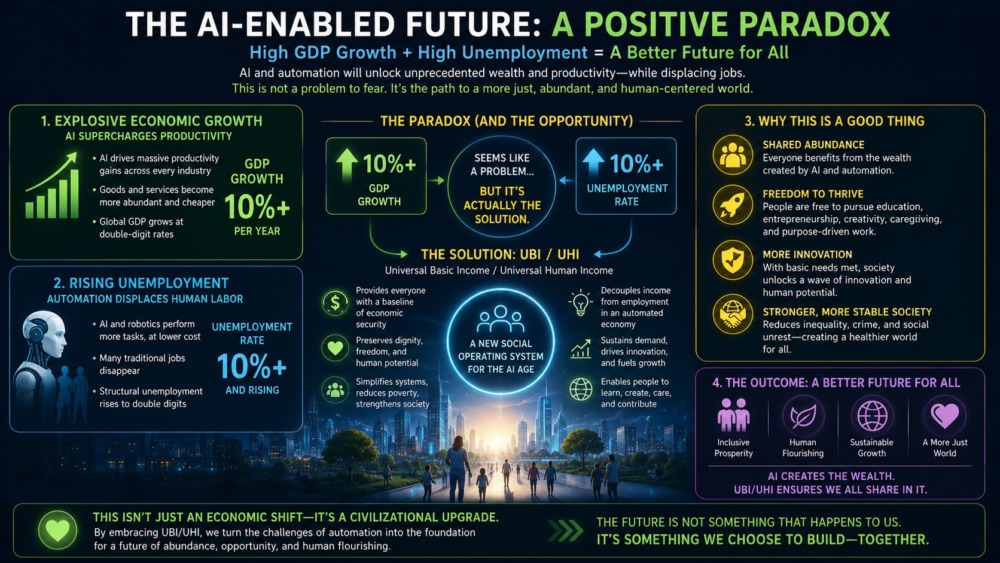
The effects of AI emerging in business are just beginning to be seen. This info-graphic offers a positive view of what that future looks like.
That is not necessarily evidence that AI is bad. It is evidence that our distribution system was built for another technological era.
Artificial intelligence can generate analyses, write software, handle customer inquiries, coordinate workflows and assist with decisions. Robotics brings that intelligence into physical space. And the robot revolution probably won’t arrive as one spectacular moment when a perfect humanoid walks into a factory and replaces everyone.
It will arrive – it IS arriving – through thousands of smaller automations.
A robotic arm performs one task. Meanwhile a mobile platform moves materials. In a whole other place, an AI system schedules production. A human remotely supervises several machines in yet another business while yet another system inspects finished products. All the while AI agents increasingly coordinate inventory and shipping across multiple firms…
Each improvement may appear incremental and isolated. Taken together, however, they reduce the total amount of human labor required to produce the same output. That’s the metric that matters. Not whether a robot looks exactly like us or whether AI can perform every part of a job. The important question is whether the whole system needs fewer human hours.
Increasingly, the answer will be yes.
Fewer Workers Does Not Mean Fewer Valuable People
This is how the AI conversation becomes a spiritual conversation. When a company says it needs fewer workers, many people hear something else. They hear that society needs fewer people. Or that some people no longer have value. That interpretation comes from centuries of conditioning linking worth with productivity.
We praise the “hard worker.” We vilify the “lazy”. In casual settings, we ask people what they do shortly after meeting them. We organize identity around occupations, describe unemployment as being “out of work,” even though unemployed people continue caring for families, solving problems, learning, helping others, creating beauty and being human.
Then we make access to survival depend on securing someone’s permission to work. The result is an arrangement in which a person can be surrounded by abundance yet denied access to it because a corporation has no profitable use for that person’s time. That isn’t just an economic contradiction; it’s a literal distortion of worthiness.
From the Positively Focused perspective, worthiness is inherent. It doesn’t come from effort, employment, productivity or social approval. We don’t earn our right to exist. Nor do we become more valuable by spending more hours performing tasks a machine could eventually perform better.
Human beings are extensions of pure positive energy—eternal consciousness focused into physical experience. We came here to explore, create, experience contrast and turn that contrast into more expansion. We didn’t come here to justify receiving food. The economy’s declining need for human labor exposes the distortion for what it is: distortion.
For centuries, the requirement to work obscured our inherent worthiness. It made survival appear like a reward granted in exchange for effort. AI now is pulling that belief into the light where we finally can look at it. That may be the deeper gift of the spiritually-based, post-labor transition.
AI isn’t taking away human value. It is taking away our ability to convincingly pretend human value comes from labor.
Protect People, Not Jobs
Fearful conversations about AI often focus on protecting jobs. But jobs aren’t the real thing people want protected. What people want is housing. Healthcare. Food. Stability. Dignity. Belonging. Purpose. They want the ability to care for their families and make choices without living in constant financial fear.
Jobs currently provide access to many of those things. So people understandably defend jobs as though jobs themselves were sacred. They aren’t. People are sacred.
This distortion about jobs is why people are sacred. Eliminating the distortion reveals that each person is a sacred being in and of themselves.
If a machine can perform dangerous, exhausting or repetitive work, why should a human being continue doing it merely to preserve the wage attached to the task? Why defend toil when what we really want to defend is the person’s access to life?
The spiritually-aligned response to automation, then, isn’t stopping technology so people remain economically necessary. It is allowing technology to reduce labor while expanding the ways people receive the resulting abundance. That is a very different objective. It shifts the question from: “How do we make sure everyone remains employable?” to: “How do we make sure everyone shares in what our civilization can produce?”
The first question attempts to preserve the past. The second begins designing the future.
How do we make sure everyone shares in what our civilization can produce?
Access Is Not Charity
Universal Basic Income naturally appears in this conversation because it offers one direct way of separating income from employment.
A basic income could preserve purchasing power as labor demand declines. It could provide breathing room for people navigating disrupted industries. UBI also could support caregiving, creative work, education, entrepreneurship and forms of contribution the market undervalues. But UBI alone doesn’t answer every question.
If a small number of corporations own the AI systems, robots, data centers, energy infrastructure and intellectual property producing most economic value, a universal payment may leave the deeper concentration of power untouched.
People may receive enough money to purchase necessities while remaining dependent on those controlling production, housing, healthcare and essential infrastructure. That’s why ownership matters.
A spiritually-based, post-labor economy may require some combination of universal income, public AI dividends, sovereign wealth funds, employee ownership, cooperative platforms, universal basic services and updated taxation of capital-intensive production. The International Monetary Fund has similarly argued that AI-era social protection may need to become less dependent on employment status, while tax systems capture more of the economic rents flowing from increasingly valuable capital.
No single policy has established itself as the answer. Nor should we pretend there is settled consensus.
For example, one recent theoretical paper argues that companies may automate more aggressively than is collectively beneficial because each firm has an incentive to lower labor costs, even when widespread displacement eventually weakens consumer demand. Its authors propose an automation tax and argue that UBI alone may not correct that incentive. That is an economic model, not proven fact or final policy guidance. But the paper highlights an important tension: what is rational for one company may become destabilizing when every company does it simultaneously.
A business benefits by reducing payroll. The broader economy suffers if too many consumers lose income. That’s the paradox. And it reveals why providing access isn’t charity. It is necessary economic circulation. More deeply, it is a recognition of shared inheritance.
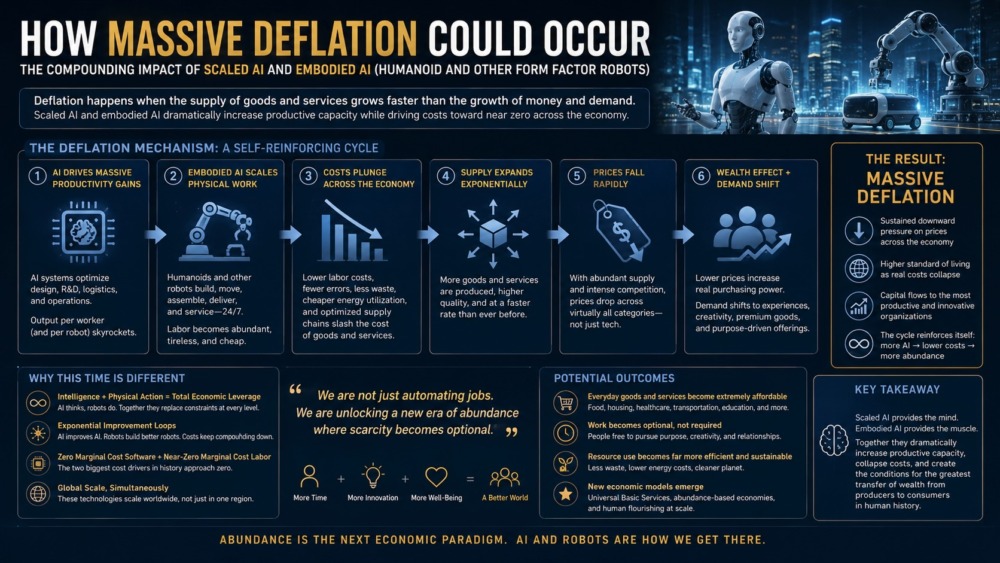
What’s interesting, however, is the paradox also offers promise as illustrated in this infographic below. The AI-enabled future offers unprecedented abundance, extremely low-cost or free goods and services as a result of massive deflation. It’s another eventuality for which we must prepare.
The AI-enabled future offers unprecedented abundance, extremely low-cost or free goods and services as a result of massive deflation. It’s another eventuality we must prepare for.
AI didn’t emerge from nowhere. It rests upon publicly funded research, accumulated human knowledge, generations of cultural production, global communication infrastructure and data created by billions of people. Robots likewise depend on centuries of engineering, science, education and collective experimentation. All that rests on a spiritual foundation that makes all of us and the world around us one.
Today’s owners certainly contributed capital, skill and risk. That contribution deserves recognition. But they did not create the foundation alone. Automated productive capacity is the latest expression of a civilization-wide inheritance. Everyone therefore has a legitimate claim upon some portion of the abundance it produces.
The Abundance Already Exists
Scarcity thinking asks how society possibly could afford to support people who aren’t working. That question looks in the wrong direction. The relevant question is what society can produce.
If AI and robotics dramatically increase productive capacity, then the goods, services and infrastructure needed for a good life become easier—not harder—to provide. The machines don’t need salaries, vacations, retirement accounts or eight hours of sleep. Once built and powered, many automated systems can continue producing at extremely low marginal cost.
So the real problem isn’t insufficient production. It is access.
We can imagine warehouses full of goods while people lack purchasing power. Empty homes while people lack money for rent. Abundant food while families cannot afford groceries. Highly capable medical systems while patients remain uninsured.
Those conditions wouldn’t demonstrate genuine scarcity. They would demonstrate a distribution system failing to understand the abundance surrounding it. Physical reality often presents contrast before expansion. The contrast clarifies what we no longer want, which launches new desires and new possibilities. AI-driven displacement represents powerful contrast.
It reveals the cruelty of tying survival to employability. It exposes the fragility of making healthcare dependent on a job. AI-driven displacement shows the folly of concentrating productive power in too few hands. It brings forward questions civilization could avoid while nearly everyone’s labor remained necessary.
That contrast is not evidence that humanity is heading in the wrong direction. It is evidence of expansion underway.
The Real Transition Begins Within
Policy, ownership and distribution all matter. But the spiritually-based, post-labor transition will not be solved only through legislation and economic design. There is an internal transition that must happen too. We must release the belief that rest is laziness, let go of the belief that suffering proves character. We must release the belief that receiving without labor is shameful. And we must release the belief that a person’s income accurately measures that person’s contribution, intelligence or worth.
Those beliefs will not disappear overnight. They are embedded deeply in families, religions, institutions and individual identity. Many people won’t know who they are when their occupation no longer defines them. That uncertainty may feel frightening. But uncertainty is also spacious.
Without compulsory labor organizing nearly every waking hour, people can discover what genuinely calls them. They can care for children and elders. They can make music, restore ecosystems, learn, travel, invent, meditate, build community and develop parts of themselves suppressed by exhaustion.
Some will still choose highly structured work. Others will create businesses or pursue ambitious technical goals. Freedom from compulsory employment doesn’t mean an end to activity. It means the end of activity coerced by survival. That is an extraordinary difference.
We Are Not Becoming Obsolete
The spiritually-based, post-labor economy asks humanity to decide what technology is for. Is it for producing more profit while excluding growing numbers of people from the resulting abundance? Or is it for freeing human beings from work we no longer need them to do?
I believe the second future is already calling us. Thankfully, I see many people leading AI-building enterprises feeling the same way.
We don’t align with that future by denying disruption. Nor do we align by condemning technology, wealthy people or companies experimenting with smaller teams. Opposition keeps attention anchored to the very reality we don’t want. Alignment offers another approach.
We can acknowledge the displacement, support structures that widen access and ownership. People can use AI deliberately. We can let contrast clarify what we want. And we can refuse the false premise that someone becomes less worthy when the labor market no longer needs them.
So when AI performs more of society’s work, let’s not ask what people must do to deserve the output. Let’s ask how the output can free them.
The economy may no longer need everyone’s labor. That doesn’t mean people have lost their purpose. It means employment and purpose finally can separate. It means receiving and worthiness finally can separate. Finally, humanity can begin moving beyond a system that forces people to prove their value before allowing them access to life.
The machines are not making us unnecessary. They are making an old belief unnecessary. And once that belief dissolves, a far more joyful civilization becomes possible.
TL;DR: AI isn’t emerging from technology alone but from collective human alignment. Both optimism and fear focus attention, crossing a threshold where reality manifests aligned with both. Those feeling fear, see the only the peril of AI, but those focused on optimism see promise. The singularity reflects consciousness expansion, not merely invention.
For decades, artificial intelligence felt like a promise perpetually just out of reach. The ideas were there, we knew the math, human imagination was certainly there too; but AI didn’t emerge until now. Instead, progress came in bursts, followed by long stretches of stagnation. Until suddenly, now, everything is accelerating.
AI moved from novelty to infrastructure in what feels like an instant. Entire industries are reorganizing around it. Conversations are shifting from “if” to “how fast.” For many, the explanation is obvious: technology finally matured and some breakthroughs happened.
But that explanation doesn’t hold water. That’s because what we are witnessing is not primarily a technological event. It is a manifestation event: AI is emerging now because humanity is aligned with the probable future reality in which its full emergence is manifest. That future is gradually becoming our collective reality.
This moment—what many call the technological singularity—is better understood as a spiritual inflection point. It is the outer expression of an inner shift that has already occurred within human consciousness. An inner, spiritual shift that ignited the unfolding we’re seeing today.
Why Progress Felt So Slow
If artificial intelligence required only technical capability, it would have arrived much earlier. By the mid-20th century, the foundational theories were already in place. Early researchers understood neural networks, symbolic reasoning, and computational learning. Those in the know understood much of the trajectory. And yet, progress stalled.
Hardware limitations alone don’t explain the stall, nor do theoretical or conceptual understandings. The deeper constraint was spiritual. It was a collective focus that kept that future probable reality’s probability very low.
Humanity spent decades telling stories about AI that emphasized danger, loss of control, and existential threat. Popular culture reinforced these narratives. There was the Terminator franchise, Will Smith’s I-Robot, HBO’s Westworld, even Kubrick’s iconic 2001: a Space Odyssey stoked fears of a revolution of machines. These and other works of art fomented a dominant fear of such futures and that fear held progress at bay.
From a Positively Focused perspective, this matters more than any technological barrier. Physical reality is not created in labs or factories first. It is created in alignment, in what can be called the Moment of Becoming — the domain where all probabilities exist before they solidify into form.
What we call reality is simply the past made visible. It reflects attention that has already been stabilized. Physical reality becomes that when enough focus on a given potential reality (the un-manifest idea) becomes chronic enough to create momentum behind the idea. When that happens, the idea will “materialize” in to a reality. When collective attention is fragmented or resistant however, that manifestation, that materialization slows. When alignment increases, the unfolding accelerates.
Artificial intelligence arrived late because we were not yet allowing it through a chronic, collective focus. And that’s what changed.
The Moment of Becoming and the Nature of Creation
Creation does not occur through effort. It occurs through alignment with what already exists as a potential in the Moment of Becoming. Every outcome — technological, social, or personal — exists first as a probability. Through attention we individually and collectively select from those infinite probable outcomes the one we want to experience.
When attention is consistent, focused, and relatively free of resistance, desired probable realities become our living reality. When attention is conflicted or dominated by fear, instead of receiving what we want as a reality, we receive “feedback” showing us what must be addressed before we can receive what we want. The “feedback” stage delays fulfilled desires.
This, therefore, reframes the question. Instead of asking, “When did we invent AI?” a more accurate question emerges: When did we finally allow AI to become real in our shared experience? The answer to that question is: now.
What changed in recent years is not just technological capability. What changed is the distribution of human attention.
Enough individuals began to engage AI with curiosity rather than fear. Enough people started using it, talking about it and integrating it into their daily lives. A critical mass formed — not of unanimous agreement, but of sufficient alignment. And that alignment is propelling the pace of AI advancement. The alignment-manifestation process is way more complex than this. I’m giving an overview. Readers can subscribe to my YouTube Channel to learn more.
Alignment does not require everyone to agree, however. It only requires that enough attention—whether positive or resistant—is directed toward the same subject. Once that threshold is crossed, manifestation becomes inevitable. This is where I support my assertions with actual real-world data. And the data are strikingly aligned to what you just read.
What the Data Reveal About Human Focus
Consider the infographic below. Globally, a majority of people—around 60%—see artificial intelligence as beneficial. That is what direct alignment looks like. That is expectation leaning toward expansion, efficiency, and possibility as it relates to artificial intelligence.
Real world survey results from several sources (Gallup, Reuters/Ipsos, Stanford)
In the United States, however, the numbers appear inverted. A majority expresses concern, skepticism, or fear about AI’s impact. At first glance, this might seem like opposition strong enough to slow or prevent its emergence. But from a deeper perspective, it does the opposite. Resistance is not the absence of alignment, rather resistance is a powerful form of it.
When people focus on what they fear—job loss, disruption, uncertainty—they are still focusing on AI. Attention is still being directed toward its presence, its growth, and its influence. The subject remains the same. And in physical reality, focus on a subject amplifies that subject. That’s why I often tell my clients “what you focus on gets bigger”. Popular opinion has a similar aphorism: “what you resist persists.”
This is why the apparent divide between optimism and concern does not cancel out. The two compound the outcome instead. Support pulls AI forward. Fear pushes against it, but in doing so, feeds it more attention. Both dynamics contribute to the same outcome. The result is overwhelming alignment to the probable future reality wherein AI dominates.
Resistance Is Participation
Opposition feels like separation; it feels like standing against something. In truth, it is often a form of strong engagement with the very thing one opposes.
When individuals say, “I don’t want this,” the subject of their focus remains present. What they’re focused on is not not wanting “this”. What they’re focused on is the “this”, whatever this is. The emotional charge intensifies the attention being given. Meanwhile the universe does not interpret the preference; it responds to the focus. This is why resistance tends to strengthen what it opposes.
In the case of artificial intelligence, a significant portion of humanity is actively pushing against it. That push is energetic participation. It increases the momentum of the very outcome being resisted. When combined with those who are directly aligned in favor of AI, the cumulative effect becomes decisive.
The decisiveness is near-guaranteed by the participation of “amplifiers”, which I talk about next.
The Role of Amplifiers
Within every large-scale shift, there are amplifiers—groups whose focus carries disproportionate influence.
In the case of AI, those amplifiers are the experts: researchers, engineers, and practitioners who are building and deploying these systems. The data show that this group is significantly more optimistic about AI’s potential than the general public. See the graphic again, but focus on the lower left hand portion. You’ll see the overwhelming optimism experts have for AI compared to the general public.
Experts are amplifying our alignment to the AI future.
This matters because their attention is not passive. It is active, sustained, applied and, as with all focus, their attention focuses into reality results consistent with their expectations. In other words, their belief in possibility is reinforced daily through direct interaction with the technology. They are not speculating; they are witnessing capability expand in real time. That concentrated alignment acts as a catalyst.
While the general population provides breadth of focus, the experts provide depth. Together, they create a feedback loop that accelerates manifestation. The more the technology advances, the more attention it receives. The more attention it receives, the faster it advances. The faster it advances, the more excited the experts get and the larger their expectations grow, which then fosters faster advances…
Why AI Is Happening Now
When all of these dynamics are viewed together, the timing becomes clear. Artificial intelligence is emerging now because enough people are aligned with its benefits; enough people are focused on its risks; experts are amplifying its development with sustained attention and collective resistance has dropped below a threshold that would delay manifestation.
Given all this, emergence is no longer optional. It becomes the path of least resistance for reality itself. This is the essence of a spiritual inflection point. It is the moment when inner alignment reaches a level where outer change accelerates rapidly and irreversibly.
Inflection points like this are common and precede any manifestation whether it be in an individual’s life or the collective experience of a nation. And, since this pattern is a fundamental spiritual principle underlying how physical reality works, it can be relied upon as a template for how to get anything wanted. All that’s required is lining up one’s focus on the desire to the degree that one’s attention causes the desired outcome to be reality’s path of least resistance.
Now, back to the macro perspective.
If AI can emerge this way, then the implications extend far beyond technology. Other possibilities—abundance, post-labor economies, medical breakthroughs, new forms of creativity—are not waiting to be invented. They exist as probabilities, just as AI did for decades. Their emergence depends on alignment reaching similar thresholds.
The future, in this sense, is not something approaching us from a distance. It is something being selected from among existing probable nows, stabilized through focused attention, and revealed through collective, sustained, dominant focus.
This framework reframes agency entirely. Humanity is not reacting to change. Humanity is generating it—through attention, belief, and emotional orientation.
The Shift in Perspective
Seen through this lens, the technological singularity is not an external force acting upon us. It is a mirror. It reflects what humanity has chosen, consciously or unconsciously, to focus on.
Take a look at the two graphics below. Together they show two sides of the same coin. They show both the trajectory of technological acceleration and the underlying mechanism: collective alignment. They depict not just where we are going, but why we are going there and how we’re going there.
Above: How people think about what’s happening.Above: What’s really happening behind the scenes.
So the singularity is not something happening to us. It is something happening through us. It’s not something to fear because it already exists and is being materialized by forces which are absolutely positive. And the more we align with the knowing that this is all happening for our benefit, the more beneficial the results will occur to us.
This perspective does not ask for control over outcomes. It invites awareness of participation. Every thought, every expectation, every emotional reaction contributes to the field of alignment. Individually, these contributions may seem small. Collectively, they determine which probabilities become reality. The emergence of artificial intelligence demonstrates how powerful that process is. It also suggests how much remains available.
If alignment can bring about a transformation of this scale, then other transformations are equally accessible. The limiting factor is not capability. It is coherence.
Conclusion: The Future We Allow
AI is not here because we suddenly became capable of building it. We have been capable for a long time. It is here because we became aligned with it—through curiosity, through engagement, and even through resistance.
That alignment crossed a threshold. Once it did, the outcome became inevitable. The same principle applies to everything else we consider part of the future. The future is not built in advance and delivered to us. It is allowed into experience through focus. It is stabilized through belief. It is accelerated through collective attention and appreciation for what’s unfolding.
What we are witnessing now is not just a technological revolution. It is a demonstration of how reality itself responds to alignment. And if that is true, then the most important question is no longer what we will build next. It is what we are willing to align with next.
Author’s note: This post is the first in my AI + Spirit series, where I explore how humanity’s spiritual evolution and the rise of artificial intelligence are inseparably linked. Together, they point us toward a future of abundance, worthiness, and awakening. The full series is unfolding on my YouTube Channel. Feel free to go there, subscribe and watch the series.
TL;DR: Worthiness is the realization that the Universe is bending over backwards to fulfill our every desire without us having to do anything to have that happen. When desire-fulfillment becomes a present-moment experience rather than a future goal, life begins reflecting that state back to us through effortless manifestations, greater peace, and a deep knowing that you are loved.
Many people spend their lives believing happiness exists just beyond the next achievement. Our minds create conditions for fulfillment: when the weight is lost or the relationship arrives, when the promotion comes through or the bank account reaches a certain number. Until then, life feels incomplete.
This way of living is so common that it often goes unquestioned. Yet beneath the endless pursuit lies an assumption that keeps fulfillment perpetually out of reach. The assumption is that something essential is missing right now.
The Positively Focused perspective offers a radically different understanding. That different understanding stems from realizing one’s worthiness.
Worthiness is not something you earn. It is not something granted by circumstances, accomplishments, or approval from others. Real worthiness is a state of knowing. It is the clear realization that you are loved by the Universe and that your life is unfolding exactly as it should.
Specifically, worthiness naturally comes through one’s awareness when a person realizes they are at the center of the Universe and that the Universe is bending over backwards to deliver every desire that person has without the person doing anything to make that happen. When a person experiences that over and over, until a basket of evidence proves what’s happening, the person then can’t help but know that they are worthy.
Perpetually unfilled desires
That knowing differs from faith, belief, or trust. Those are three distinct things. Faith is necessary when one has no evidence of something. Belief emerges when a little evidence begins to appear. Trust develops when enough evidence accumulates that confidence becomes natural.
Worthiness goes beyond all three. When worthiness shows up you simply know. You have produced so much evidence, the knowing is certain.
In worthiness, a deep peace replaces uncertainty. Security arises without needing external confirmation. Life no longer feels like a struggle to obtain what is missing because you recognize that everything you desire already exists in the process of becoming. This understanding sits at the heart of the Positively Focused framework.
The physical world is always reflecting your state of being. When you move through life convinced that fulfillment exists somewhere in the future, reality mirrors that experience back to you. The future remains perpetually ahead. Desire remains perpetually unfulfilled.
Something remarkable happens when fulfillment becomes a present-moment experience instead. Rather than focusing on the absence of what has not yet manifested, awareness shifts toward the presence of what already exists vibrationally. You begin feeling the reality of your desires before they appear physically.
Lack gives way to anticipation. Anxiety transforms into appreciation. Effort becomes allowing. From that state, manifestations unfold far more naturally because your vibration is no longer contradicting what you want.
A client of mine named Lisa beautifully illustrates this transformation.
It’s not faith, belief or trust. Producing a basket of evidence that the Universe delivers your desires with no effort on your part is what creates the state of worthiness from within you.
No Longer Postponing Happiness
Over several years of practice, she moved through substantial contrast. Contrast refers to experiences many people label as negative but which actually serve a valuable purpose. These experiences help clarify desires, refine preferences, and guide expansion. Every challenge contains information about what you truly want.
Lisa experienced plenty of contrast throughout her journey. Relationships presented opportunities for growth. Life circumstances invited deeper self-awareness. Through it all, she steadily developed the ability to use contrast as a tool rather than viewing it as evidence that something was wrong.
Eventually, she arrived at a realization that changed everything. For the first time in her adult life, she noticed that she was no longer postponing happiness. She wasn’t waiting to lose weight before feeling good. She wasn’t waiting for financial improvements. She wasn’t waiting for relationship milestones or future achievements. Day after day, fulfillment was already present.
What made her insight especially powerful was her recognition that external conditions were not creating her happiness. The state had emerged before many of the physical manifestations she desired had fully arrived. That distinction matters enormously.
That’s because many people assume happiness is the result of getting what they want. In reality, getting what you want often followsgenuine happiness. The state comes first. The external reflection comes afterward.
The Now Contains Everything
Lisa described experiencing contentment and joy so consistently that she no longer felt dependent on future events for emotional relief. Even goals she still wanted to achieve had lost their emotional urgency. Desire remained, but neediness disappeared. That is the signature of worthiness. When nothing is missing emotionally, life begins responding in extraordinary ways.
Long-held desires unfold and goals are met. Relationships continue expanding. Yet those experiences arrive against a backdrop of wholeness rather than longing. Creation becomes playful rather than desperate. This is why so many spiritual traditions emphasize the present moment. The power to create has never existed in the future. It has always existed here. Now is where alignment happens. Now is where worthiness is realized. The now is where the vibrational reality of your desires becomes accessible.
The irony is that many people spend years chasing a future state that can only be experienced in the present. They seek fulfillment through external change when fulfillment itself is the very condition that allows meaningful change to occur. Once you understand this, life begins to feel different.
Contrast no longer appears threatening. Delays lose their emotional sting. Manifestations become exciting rather than necessary. The Universe feels less like an unpredictable force and more like a loving partner responding to your state of being.
So worthiness, then, is not about becoming someone else. It is about recognizing who you have always been. Beneath every desire is a longing to feel complete, secure, loved, and connected. The beautiful truth is that those experiences are available before any manifestation arrives. When you discover that nothing essential is missing right now, you stop trying to earn your happiness.
Instead, you begin allowing it. And from that place, life has no choice but to reflect your wholeness back to you.
Editor’s Note: Much of my attention is focused now on our YouTube Channel where I’m using multimedia to share stories of people benefiting from the Positively Focused framework. Feel free to visit us there.
TL;DR: The author shares why working with multimillionaires is deeply rewarding, revealing that real joy comes from alignment, not wealth. And yet, the author enjoys working with wealthy people because financially resourced clients can go deeper into the transformative Positively Focused practice.
When I look at my client roster, about half of them are multimillionaires. I love that. There’s something uniquely satisfying about helping people who have already “made it” by society’s standards find something even more valuable: genuine alignment with who they really are.
One reason I enjoy working with multimillionaires is simple: they’re relaxed about paying for sessions. At $75 per session, the investment doesn’t stress them out. That’s a big deal because it means we can focus on the work without money anxiety clouding the process. Their energy is freer, their receptivity higher, and our momentum together flows faster.
The Freedom to Go the Distance
Time and money are the two main resources most people think they need before they can “finally” focus on themselves. My wealthier clients already have both. That means they can go deep. They can commit to the long-term process without rushing for quick fixes or stopping when life gets busy.
That’s important. The most joyful part of the Positively Focused framework isn’t the early wins—though those are exciting. No, the most joyful part is the advanced practice. It’s the space where we look deep into the human spirit and discover something extraordinary about each and every one of us.
There we develop sustained alignment, vibrational mastery, which allows truly remarkable things to happen, and real-time creation of desired realities. The deeper we go, the more those shifts compound into something even more astounding. And the more time in the practice, the better the shifts get.
When I work with someone who can afford to keep showing up for that level of practice, it’s a gift to us both. They get to experience their life transforming deeply from the inside out, and I get to witness and guide the process in its fullest expression.
I enjoy working with millionaires because they have the resources to go the distance.
Money Doesn’t Buy Happiness
There’s another reason I love working with multimillionaires, and it has nothing to do with session fees or scheduling flexibility. It’s about the universal truth people love to repeat yet rarely understand: money doesn’t make you happy.
Every multimillionaire I work with is dealing with something—often something deeply personal or emotionally challenging. That’s not surprising. If they were completely satisfied, they wouldn’t be coming to me. And when they resolve that thing they came for, then we’re free to explore the depths of conscious awareness.
Seeing this play out over and over is such a beautiful confirmation of what I teach. Joy, fulfillment, and a sense of meaning don’t come from bank accounts, cars, or vacations. They come from alignment with your Broader Perspective, from living in harmony with the larger, eternal part of us.
When these clients step into the Positively Focused practice, they begin to experience what I call “true wealth.” That’s the wealth of being. It’s the deep knowing that who you are—right now—is whole, sovereign, and worthy beyond measure. No market fluctuation can shake that. No life circumstance can touch it.
Money can amplify your life, yes. It can expand your options, give you access to new experiences, and even speed up some manifestations. But the real joy comes from who you’re being while you live those experiences. My multimillionaire clients come to see that the joy they’ve been chasing is already here, in them, available in every moment. Not in the amount of money they have.
Why It’s So Fulfilling
My income comes from helping people move through the Positively Focused framework. That’s a privilege I never take for granted. Working with people who have the means and commitment to reach advanced levels of the practice makes the journey all the more fulfilling.
For them, the rewards are exponential. For me, there’s nothing quite like watching someone who has “everything” realize they already had the most important thing all along: themselves.
Money doesn’t make you happy. Alignment does. And when those two meet—when someone is both financially resourced and vibrationally aligned—their life becomes something truly magical. That’s why I love working with multimillionaires.
TL;DR: A viral meme asked women: “Would you rather encounter a man in the woods or a bear?” Most women chose the bear. Why? This post explores the deep energetic reason behind that answer — not as a judgment of men, but as a reflection of distorted masculine energy that’s dominated our culture for millennia, culminating in circumstances such as those surrounding the motherless.com. More importantly, this article points to a sacred rebalancing now underway — a divine recalibration between masculine and feminine energies, beginning not in systems, but in individuals.
There’s a meme that swept the internet not long ago. Its message was simple, sharp, and deeply telling. It also revealed something many people, especially women, understand. The meme asked a question: “If you’re a woman walking alone in the woods, which would you rather see: a bear or a man?” The overwhelming response? The bear.
The response ignited a thousand conversations. Conversations about gender, safety, trauma, and how deeply imbalanced the world feels for so many. Especially women.
But beneath the discourse and defense was something more ancient. There lurked something more “true”, more than a flash of cultural commentary. The discourse symbolized an energetic signal, one exposing long-term distortions of masculine energy…and the sacred recalibration now stirring in all of us.
I’m not writing this to amplify blame or fear. Instead, this post is about powerful, divine balance — and how the return to that balance begins not in systems or structures, but in the inner lives of individual people.
Let’s get to it.
Masculine and Feminine Are Not What You Think
Before we can unpack what “the bear” really represents, we need to untangle some ancient confusion. Masculine and feminine energy have almost nothing to do with gender. They are the primordial forces of creation, present in every being, every body, every moment. You could call them cosmic functions — two aspects of the One Source:
Feminine energy is receptive, creative, intuitive, magnetic. It dreams, it listens, it gestates, it expands. Masculine energyis expressive, active, devotional, directional. It moves, it structures, builds, it serves. In their divine forms, these forces are not in opposition. They dance together.
The masculine exists to serve the feminine’s vision — to bring her dreams into form. When the inner feminine imagines, the inner masculine moves. This is the sacred balance. It is the original template. And this dance is alive inside each of us.
That’s right. Men are not 100 percent masculine. Women are not 100 feminine. Each individual, regardless of gender, represents varying balances between these two divine, eternal energies. And those energies rarely, if ever, show up in 50/50 balance.
So women don’t have a lock on feminine energy. Men don’t have a lock on masculinity. Both genders embody the dance. And both genders can lose their way.
When the Balance is Lost
Something shifted over millennia. Not because of some evil force or accident — but because humanity, in its evolution, forgot. What did it forget?
It forgot the dance. The masculine got elevated beyond its role. Action got prized over intuition and then we made a mockery of the latter. Force superseded feeling and we lost the meaning and benefit of emotions. Power overpowered presence and we forgot that stillness is extremely valuable, not laziness. Doing supplanted being and in the replacement, we elevated action far beyond its proper place.
As all that happened, the feminine — in both men and women — became muted. It got labeled as weak, frivolous, irrational and dangerous. That creative force got pushed underground. But the distortion wasn’t just external. Everyone internalized it too.
Men, disconnected from their inner feminine, grew brittle, hierarchical, aggressive and afraid of stillness. Women, in order to survive in male-shaped systems, learned to mimic men’s distortions and their distorted traits. They began valuing drive, grind, hustle and control, just like men.
The human world grew to confuse distortion for power. And now, we’re reckoning with the result. Which brings us back to the meme.
Men, disconnected from their inner feminine, grow brittle, hierarchical, aggressive and afraid of stillness.
Why Women Chose the Bear
Why would a woman rather meet a bear in the woods than a man? Because for many, the bear is more predictable. Think about it. It doesn’t gaslight, denounce or punish vulnerability. The bear acts on instinct, which more often than not is respectful of life and aligned to being. The distorted masculine acts on insecurity.
I believe that what women fear isn’t manhood. It’s what happens when masculine energy is severed from love. The man in the woods — in the meme — isn’t just a person. He’s an archetype. He’s a symbol of every time masculine energy was used to dominate rather than to serve.
The interesting thing about the meme, however, isn’t its truth. What’s interesting about it is its function. That meme isn’t about accusing any one of anything, even though some men react to it as though it is accusing them. That meme is actually a mirror. It is a mirror and a summons.
Some men can’t see themselves in the mirror nor hear the summons. That’s why they become defensive and lash out in their insecurity as men. Remember, men, like women, represent a blend of masculine and feminine energies. Insecurity shows up when that blend gets out of calibration. And insecurity tends to make people want to control their environment including other people. That control often looks like blame, attack, manipulation, etc. Control usually looks that way because the one trying to exercise control, themselves, feels blamed and attacked. When attacked, such people will lash out in defense or even become violent.
When a man feels defensive in the face of this meme then, undoubtedly, that man is insecure, meaning, his calibration is out of whack.
That’s the problem with some men. Not their manhood.
Time for a Recalibration
Masculinity isn’t broken. It doesn’t need to be fixed. It needs to be remembered in its sacred form. That remembrance is a recalibration. Not healing. For there’s nothing to heal, because there are no wounds. All that’s required is a return to the knowing of All That Is. A remembering of the dance. A restoration of balance. It doesn’t happen in headlines or viral posts. And it certainly doesn’t happen quick. It happens inside individuals — slowly, sometimes messily, often unconsciously.
It happens in the man who pauses before acting, and listens instead. Or the man who, after acting, sees what he’s done and pauses, and then listens. It happens in the woman who chooses rest without guilt. The woman who realizes she too has absorbed distortion if she believes her value comes from action or validation from outside herself. It happens in the creator who builds from inspiration, not urgency. The creator who creates because he loves creating, not because he’s seeking followers or money.
This recalibration is also eternal. It doesn’t unfold all at once — though it can. It is a spiral, not a straight line. Because of that, again, it looks messy, and that’s okay. It’s ok because we’re eternal beings. We have the time.
So even when the process looks chaotic or backward or messy, the calibration is always unfolding. Creation doesn’t move in straight lines. It moves in spirals, swells, and surprising synchronicities. And the meme women so celebrated a few years ago is part of that recalibration. So is the discovery of the Epstein Class of men. So is the discovery of motherless.com and the “manosphere”.
This image portrays the role of feminine and masculine energies. Masculine energy isn’t’ subservient to feminine energy, yet it serves that energy through action. The feminine energy gets it all started by sparking creation, ideation.
It Begins with One Person
The collective shift begins with individual recalibration.
This is not abstract for me. I live it. In recent months, my dreams have shifted significantly. Where once radiant feminine figures visited me nightly, now I find myself among machines, messes, missions, chaotic movement and a lot of angry, sometimes, violent, larger-than-life men.
And yet — I feel the divine choreography. These masculine-coded symbols aren’t a departure from the feminine. They are her creations taking form. These creations are the masculine in me rising to serve her, who also is in me.
My waking life mirrors this: blog posts, YouTube projects, clients, nascent apps aligned to my positively focused practice…all flowing together in precision. But none of it feels like striving. Instead, it feels like devotion. My masculine energy (action) is no longer compensating. It’s consecrated.
This is the sacred marriage of feminine and masculine — and it happens not in theory, but in practice. Practice over time, time honored, joyfully passed through and used in devotion of creation. It took a long time to get here. But I’m here. That’s what matters. And if I can be here, anyone can.
Each person must make the choice, however. It’s not automatic because we enjoy free will. So we each must choose. And choose wisely. A non-choice is a choice. It’s the default choice – to continue with current momentum of choices. We’re witnessing that default choice playing out especially so in the United States.
How The Bear Becomes a Brother
When we embody this inner balance, however, the “bear” dissolves. The man in the woods becomes safe again. He hasn’t been tamed. Instead, he’s remembered his role. When men reconnect to their inner feminine, they become of service, not scandalous. When women trust their inner masculine, they create with clarity, not codependence. When all of us integrate these energies, the forest — and the world — becomes a sanctuary again.
It’s far from utopia. Indeed, it’s something better than that. It’s real, happening. And it begins with us. It begins IN us. Both men and women.
What we’re witnessing in our global culture — the chaos, the contrast, the callouts — is recalibration, not regression. The fall of Orban’s Hungary is a sign. So is the collapse of Trump’s administration.
We’re remembering the dance between inspiration and action. Between creation and movement….dreaming and doing. And it’s happening everywhere — in whispers, in dreams, in pause points. It’s happening in prayer, in heartbreak, in blogs like this one. It’s also happening on social media, through memes and the great distributed information engine social media represents. But most importantly, it’s happening in more and more individuals.
The world isn’t being destroyed. The world is rebalancing. That rebalancing is happening one sacred human at a time. In that context, the bear becomes a totem. A totem of change.
Whether you’re a man or a woman, let that change begin with you.
TL;DR: The author shares how a client’s repeated encounters with one woman revealed hidden beliefs, offering a powerful chance to align with his true relationship desires and release old self-loathing patterns.
Sometimes an angel delivers a message so profound, it can’t be ignored. That is, if you hear the message. For my client Dale, that angel’s name was Tracy and her message revealed an important truth.
You might remember Tracy from a previous blog post, where Dale first met her in a Walmart. That brief encounter lit up something inside him — a powerful attraction, a feeling of “this could be the one.” Then, in true Positively Focused fashion, the next encounter came at Safeway, but this time, instead of elation, Dale spiraled into extreme negativity after the encounter.
Both meetings were orchestrated to reflect exactly where Dale’s vibration was in relation to his desire for his ideal partner—someone he’s nicknamed “Carmen.” His Broader Perspective couldn’t have picked a better angel than Tracy to deliver the message.
The Pattern Continues
Recently, the rendezvous didn’t stop. Dale spotted Tracy again. This time at Fred Meyer, another grocery store. And then again at Walmart.
From his perspective, the repeated appearances were frustrating. “Why do I keep seeing her?” he asked. “I want Carmen, not Tracy.”
But here’s the thing: Tracy is Carmen — vibrationally speaking. Or rather, she’s the perfect vibrational match to where Dale is right now. The Universe isn’t bringing Tracy around to taunt Dale. She’s here so Dale can see his now vibration clearly, in living, breathing form.
Until he soothes the stories Tracy’s presence activates, he can’t rendezvous with Carmen. It’s not that Carmen isn’t out there. It’s that Dale isn’t yet a match to her frequency. Tracy’s reappearances are his Broader Perspective saying, “Let’s calibrate this together.”
The Smile That Broke the Spell
During our most recent session, Dale described a moment when another woman—someone entirely different—smiled at him.
That could have been a manifestation of alignment. But instead of letting the smile land, his thoughts took a hard left turn. This encounter happened just after seeing Tracy again. The timing couldn’t have been more perfect. For it triggered the revelation Dale needed.
“I’m a pretty horrible person,” he said to himself as though talking to the smiling woman. “Better watch out, I’m a monster.”
In that instant, he felt his heart physically shrink and harden into what he described as “a tiny rock.” That’s the body’s way of mirroring vibration in real time. His stories of unworthiness and danger around intimacy triggered a full contraction.
Then something beautiful happened: Dale used a practice we’ve been working on—a particular form of meditation that soothes the nervous system and reopens the heart. Slowly, he felt his chest expand again. The rock softened, then warmth returned. Shortly thereafter Dale’s vibration lifted.
Tracing It Back
As we unpacked his reaction, Dale named the core of his belief system: “Basically, it’s self-loathing,” he said. That might sound harsh, but it’s honest. And honesty is the first step toward shifting any vibration.
In our conversation, we traced some of that belief to moments in his youth—around ages 14 and 15. Back then, he had social experiences at school that he interpreted as negative. I offered contrasting stories to show him those events could have been seen differently. But the meaning he assigned back then stuck.
One powerful example came from an exchange with his father. In a casual conversation, the word “fag” came up. His father’s tone and the context hit Dale hard. That’s because Dale possesses some effeminate qualities which have him sometimes mistaken by others as gay.
Since that conversation with his father, he associates certain parts of himself with shame, unworthiness, and danger. That early conclusion grew into the self-loathing still coloring his interactions today.
Repeatedly seeing the same woman helped Dale tune in his vibration.
Tracy as an Angel
When you see it from the Positively Focused perspective, Tracy isn’t “the wrong woman” for Dale. She’s the perfect angel for the moment. She brings the exact blend of attraction and activation that lets Dale see the vibration he’s holding.
The more intense the reaction—whether joy or frustration—the more clearly we can spot the belief underneath. That’s what makes Tracy’s role so powerful. She’s not here to be Carmen. She’s here to help Dale become Carmen’s match.
In other words, she’s not blocking the door to his desire. She’s showing him where the hinges are rusty. In other words, she’s not blocking the door to his desire. She’s showing him where the hinges are rusty. And when he cleans up beliefs he holds which run counter to enjoying relationship with another, he’ll manifest the relationship he wants. Not before.
When the Universe Sends the Same Angel Twice…or Four Times
Dale’s work now is about shifting from “I’m a monster” to “I’m magnificent.” That’s not a one-and-done mental affirmation. It’s a vibrational recalibration.
Each time Dale feels the rock-hard heart, he has the opportunity to soften it again — but by meeting it with presence, curiosity, and love. Every Tracy sighting, therefore, becomes a training ground for staying open in the presence of activation.
From there, his Broader Perspective can line him up with Carmen as a natural rendezvous born of his new, aligned vibration. The brilliance of this whole unfolding is how deliberate it all is.
Dale didn’t “accidentally” run into Tracy four times. He didn’t “randomly” get smiled at by another woman only to spiral. His Broader Perspective curated these moments to reveal exactly what’s active in him right now, so he can choose alignment over old momentum.
From Self-Loathing to Self-Loving
That’s what makes this work so joyful. Even the moments we wish would stop happening—like repeated encounters with someone who activates our most painful beliefs—are gifts. They’re opportunities to step closer to the version of ourselves we’ve been asking to become.
When you understand that, you stop trying to escape contrast and start using it. You stop seeing “wrong person, wrong time” and start seeing “perfect mirror, perfect moment.”
Dale’s journey with Tracy is far from over. Whether she appears again or not, the real story is about his willingness to meet himself with compassion, to soften the rock, and to remember his inherent worthiness. To fall in love with himself in other words.
And when he does, Carmen will be right there— as a reflection of the love he’s cultivated within.
TL;DR: The author describes how positivity reflects the universe’s fundamental nature. Aligning with that perspective reconnects us with our broader consciousness, softens resistance, and allows manifestations to unfold through natural expansion.
Many people assume positivity is simply a psychological technique. In that view, positivity is something we adopt to feel better or to cope with difficult situations. The Positively Focused perspective approaches the idea differently. Positivity is not merely a mood or emotional preference. Positivity reflects the fundamental energetic orientation of the Universe itself.
Understanding that distinction changes how life is perceived. When positivity is treated as an emotional strategy, it appears optional or situational. When positivity is understood as the nature of the Universe, it becomes the most direct way to align with how reality actually functions.
The ability to manifest whatever we want becomes accessible through that alignment.
The Expanding Nature of Existence
The Universe can be understood as a single, vast consciousness expressing itself in countless forms. Spiritual traditions have referred to this source in many ways. Some call it God. Others describe it as Source, pure consciousness, or All That Is. Language inevitably distorts the idea because human language separates what is actually unified. Still, the concept helps illustrate how existence unfolds.
Expansion appears to be a constant property of that universal consciousness. Expression leads to more awareness. Experience leads to greater understanding. Each expression contributes something new to the whole.
One way to picture this is to imagine the Universe projecting aspects of itself outward in order to know itself more fully. Those projections include every element of physical reality. Planets, ecosystems, ideas, and human beings all participate in that unfolding exploration.
Every experience contributes to the awareness of the whole. Some experiences seem brief. Others expand outward through many layers of discovery. Regardless of the path taken, each contributes something new to the expanding awareness of the Universe.
Because every experience ultimately adds to that expansion, the Universe interprets all experiences as valuable, as positive.
Everything in existence is positive. Even those things you may not like being here.
Why the Universe Interprets Everything as Good
Human beings often interpret events through a narrow lens. Situations that feel painful or confusing may appear meaningless or unfair from a limited perspective. The broader perspective of Universal consciousness sees those same events differently.
Expansion is inherently positive from the vantage point of the Universe. Every new experience adds information, awareness, and possibility. That contribution means the whole becomes more capable, more expressive, and more aware.
Over immeasurable spans of time, that perspective has generated enormous momentum. Momentum refers to the force created when movement continues consistently in one direction. A cargo ship takes considerable distance to slow because of its mass and forward motion. Consciousness behaves similarly.
The Universe has focused on expansion, discovery, and awareness for what can only be described as eternity. As a result, positivity has become the dominant momentum within existence itself. Reality, therefore, naturally interprets events through the lens of expansion rather than a moral lens.
From that perspective, everything that occurs contributes to the unfolding of something larger.
The Human Perspective Is Naturally Limited
Physical life offers a very specific viewpoint. A human being experiences reality through the senses, through beliefs, and through interpretations shaped by culture and memory. That perspective provides valuable contrast, yet it is also narrow.
Events that appear negative from a human viewpoint may still contribute to expansion in ways that are not immediately visible. The broader perspective of consciousness recognizes the larger trajectory of each life. It perceives patterns that cannot be seen from within the moment.
That broader awareness exists within every human being as well. The Positively Focused framework refers to this expanded awareness as the Broader Perspective. Only a portion of consciousness inhabits the physical body. The larger aspect remains connected to the full awareness of the Universe.
From that vantage point, life experiences appear meaningful, creative, and often exhilarating.
Emotional Guidance and Alignment
Emotions play a crucial role in helping human beings navigate this difference in perspective. Feelings do not arise randomly. Instead, emotions indicate the degree of alignment between physical interpretation and broader awareness.
Positive emotion signals resonance. Alignment with the Broader Perspective produces feelings such as appreciation, enthusiasm, and ease. Negative emotion signals dissonance. Resistance, frustration, or anxiety usually appear when interpretation conflicts with the larger perspective.
Negative emotion does not function as punishment. Guidance is the real purpose. Emotional discomfort simply indicates that interpretation has moved away from the perspective of expansion and possibility.
Recognizing this guidance system transforms how emotions are understood. Instead of viewing feelings as reactions to circumstances, they become indicators of alignment.
Emotions indicate the degree of alignment between physical interpretation and broader awareness.
Positivity as Alignment With Source
When a positive orientation toward life is chosen, perception begins to shift. Events that once appeared obstructive often reveal themselves as redirections or clarifications. Possibilities that previously seemed invisible become easier to notice.
Alignment with positivity, therefore, allows resistance to soften. That shift does not force manifestations into existence. Rather, it allows awareness to recognize what is already unfolding.
Manifestation can be understood as a cooperative process. Desires generate movement within the Universe. Opportunities begin arranging themselves through countless interactions and circumstances. Alignment enables participation in that unfolding.
From that perspective, manifestation resembles arriving at the right coordinates in time and space to witness what has already been developing.
The Real Joy Lies in Expansion
Physical manifestations bring satisfaction, but the experience is often temporary. Receiving something long desired can feel exhilarating at first. Over time, the novelty fades and attention naturally moves toward the next expansion.
The deeper reward of existence, therefore, lies in the journey toward those manifestations. Anticipation, discovery, and growth generate a sense of aliveness that physical outcomes alone cannot sustain.
Movement toward expansion continually renews that sense of vitality. Each desire initiates a new chapter in the unfolding exploration of life. In this way expansion itself becomes life’s purpose. And when that happens, we’re maximally aligned with All That Is.
Understanding the Idea of “Toxic Positivity”
Cultural discussions sometimes describe positivity as toxic. The phrase usually appears when optimism seems disconnected from emotional reality. From the Positively Focused perspective, the concept arises for a different reason.
Chronic alignment with negative interpretation creates strong momentum. When someone operating from that momentum encounters a genuinely positive perspective, the contrast can feel uncomfortable. The dissonance may even produce irritation, disbelief and even pain.
That reaction does not indicate that positivity is harmful. Instead, it reveals the gap between current interpretation and the broader perspective of expansion. Positivity itself cannot be toxic because it mirrors the natural orientation of the Universe.
Choosing Alignment With Expansion
Life becomes easier to navigate when positivity is understood as alignment rather than denial. A positive perspective does not ignore challenges. It simply interprets them within the larger context of expansion.
That orientation reconnects awareness with the broader perspective guiding every life trajectory. Emotional clarity increases. Guidance becomes easier to recognize. Manifestations appear less like struggles and more like natural unfoldings.
Human beings are not separate from the Universe exploring itself. Each life represents an extension of that universal consciousness expressing through form.
Positivity therefore functions as the Universe’s native language. Aligning with it allows life to be experienced from the same expansive perspective that created it in the first place. Positivity then, is not just a psychological technique or something we adopt to feel better or to cope with difficult situations. It’s also not something that creates toxic outcomes or perspectives.
Instead, it’s the basis of All That Is and when aligned with it, we create for ourselves a world in which everything we desire happens with ease.
TL;DR: The author explains why putting yourself first restores alignment with everything you’re wanting, stabilizes identity beyond ego, and reorganizes reality through vibrational coherence rather than self-sacrifice or insecurity. They then encourage readers to discover the joy that comes from putting one’s self first.
Civilization has trained us to believe that putting ourselves first is selfish. From an early age, we’re taught that virtue looks like sacrifice, that maturity looks like self-denial, and that goodness means placing others ahead of ourselves. That conditioning runs deep. So much so putting others first feels moral, responsible even.
Yet from the vantage point of the Positively Focused framework, that entire premise rests on a misunderstanding of how physical reality actually works.
There is no one else in our life experience in the way we think there is. The people we interact with are not independent sources of our satisfaction or dissatisfaction. They are reflections—emanations responding to our internal state on the subject they represent. When we attempt to put others first, we are not elevating something outside ourself; we are misaligning the only point of creative authority that exists in our experience: Us.
Placing ourselves behind others creates disempowerment. Disempowerment naturally breeds insecurity. Insecurity then produces distorted thinking and negative emotion. That insecurity does not remain internal. It gets reflected back to us through lived experiences, experiences I call manifestations.
Those manifestations often feel negative, but they are actually positive feedback. They reveal where we are disconnected from our Broader Perspective and operating from a diminished sense of self. In that way physical reality acts as information we can use to true up to our eternal, all-knowing state.
Understanding this changes everything. Putting ourselves first, then, is not selfishness in the conventional sense. It is structural alignment with the mechanics of reality.
The Order of Operation
Within the Positively Focused framework, I teach what I call the Order of Operation. This subframework clarifies what “putting yourself first” actually means in practice. It does not imply ignoring others or acting carelessly. Instead, it establishes the correct sequence of alignment.
The first priority is our relationship with our Broader Perspective. That deeper aspect of us—what some might call pure positive energy or divine consciousness—is the source of our life experience. Alignment here determines our vibrational tone. When that relationship is strong, clarity increases. When it is neglected, confusion follows.
The second priority is our relationship with our emotions. Emotions function as indicators. Negative emotion signals that our thoughts are misaligned with our Broader Perspective. Positive emotion signals resonance. Emotions then act as precision instruments helping us create lives we love.
The third priority is our relationship with ourselves. This means choosing satisfaction, ease, joy, freedom, and self-respect as daily practices. Such choices affirm our existence and so such choices not only feel good, they create pleasant manifestations (life experiences). Choices made from obligation, rooted in guilt or fear do not feel good. Such choices create unpleasant manifestations.
Everything else—career, partnership, family, contribution—comes after these three relationships. That order matters because our entire experience flows from the alignment between us and our Broader Perspective. When that connection is strong, life reflects coherence. When it is strained, reality mirrors discord.
In the Positively Focused Practice we learn how to use the Order of Operation to our advantage and how to maintain it in our lives.
Why Serving Others Fails When We Abandon Ourselves
Many people believe that prioritizing others is the highest form of service. In practice, the opposite is true. Attempting to satisfy others while disconnected from ourselves creates a cycle of mutual insecurity. We cannot fulfill another person’s needs in a lasting way because their satisfaction does not originate from us. When we try, demands increase. Alongside increased demands come more expectations that we behave in certain ways. Frustration builds for both parties when we don’t meet those demands. In time, resentment and a feeling of being unseen can show up leading to “failed” relationships.
Service is vibrational before it is behavioral. How we be is more influential than what we say or do. A sovereign, aligned presence stabilizes others naturally. Someone stabilized in their self-knowing is pleasant to be around. A disempowered presence spreads unease, regardless of good intentions. People can feel this disempowerment emanating from us.
This is why Abraham’s teaching about sacred selfishness is so direct. Entertaining ourselves, pleasing ourselves, connecting with ourselves, enjoying ourselves—these are alignment practices. When we are selfish enough to reach for that connection first, we become an enormous gift to everyone around us.
We literally create others by degree we align with ourselves.
The Ego Is a Function, Not an Identity
Where many people become confused is in their relationship to ego. Modern psychology often treats ego as identity. From the Positively Focused perspective, ego is a function not an identity. Its role is similar to our lungs or our heart. Our lungs process oxygen and carbon dioxide. Our heart circulates blood. The ego generates the perception of separation.
Without ego, we would experience ourselves as fully unified with physical reality. Ego creates the illusion of duality so we can navigate the physical environment. That function is useful. It becomes destabilizing only when we collapse our identity onto it.
When identity fuses with ego, insecurity becomes inevitable. The ego was never designed to hold our sense of self. It was designed to facilitate contrast and perception. True identity resides in pure positive energy. That identity stabilizes only when we maintain our Order of Operation thereby putting ourselves first.
What Insecurity Looks Like in Practice
Recently, I worked with a new client who was drawn to advanced manifestations after watching many of my videos. Exposure to those videos alone had already improved her life significantly, she said. At the same time, underlying insecurity remained active in her. That insecurity expressed itself as insecurity-based demands she leveled on me, and expectation that I treat her as an exception to my other clients. She wanted me to treat her special, in other words.
But the Positively Focused structure works for everyone. That’s why I can offer a full money-back guarantee that clients get results. Structure can feel threatening when ego seeks control. Requests for special tailoring and resistance to proven methods often arise from a desire to stabilize identity externally. Ultimately, this new client chose to self-select out of the practice. It was a perfect example of misalignment revealing itself.
What happened next was instructive. As that misalignment exited, alignment flowed in, in my experience. Another client increased their session frequency resulting in income which replaced the potential income from this new, now ex-client. Meanwhile, a totally different new client began onboarding.
A generational ripple appeared as well as this new client is a family member of a long-term client. Family members becoming clients happen frequently because changes family members see in their brothers, sisters, moms, etc. are so profound they want what they see in their loved one.
Reality reorganizes around vibrational clarity. When we put ourselves first, what does not match falls away. What does match steps forward.
Identity Anchored in Pure Positive Energy
We are not our ego. Nor are we our insecurities, diagnoses, or traumas or personality test results. We are pure positive energy expressing through form. That identity becomes accessible when we prioritize alignment above approval.
Self-love is not narcissism it is stabilization. Sovereignty shows up naturally when coherence with All That Is happens. When our identity rests in pure positive energy, our influence increases without needing force. Emotional steadiness replaces reactivity. Contribution becomes effortless as does getting everything we want.
Putting ourselves first does not diminish others. What it does do is it empowers others. How? By modeling alignment, we become the invitation for others to find their own alignment. That’s what happens when family members of clients become clients themselves.
In alignment life experience that once felt disruptive becomes valuable feedback. Negative emotion becomes powerful guidance. Life improves not through control, but through calibration and allowing. The most generous thing we can do, therefore, is maintain our order of operation. From there, everything else unfolds naturally.
IInterested in living from that level of alignment? Then find the teacher who resonates with you. Implement the principles then observe what reorganizes as life opens up. When identity stabilizes in pure positive energy, life does not become perfect — it becomes coherent. And coherence is powerful medicine.
TL;DR: The author asserts that resisting AI amplifies fear, while internal alignment reshapes perception. By releasing opposition and prioritizing vibrational steadiness, individuals experience technological change ad the future that’s bringing as opportunity rather than threat.
For many people right now, the future feels less like an invitation and more like a disruption. Artificial intelligence is advancing faster than expected, familiar career paths feel unstable, and economic narratives appear increasingly polarized. From that vantage point, it makes sense that anxiety, resentment, defensiveness and anti-Ai sentiments are becoming more common responses to everyday news.
When life starts to feel uncertain, the instinctive reaction is often to push back. People oppose systems, blame institutions, and direct frustration toward wealthy individuals or technological leaders who seem to benefit most from change. That response is understandable, yet it quietly shapes how the future is experienced on a personal level.
From a Positively Focused perspective, the most consequential factor isn’t what is unfolding externally. The determining factor is how a person is internally oriented toward what is unfolding. That orientation influences what becomes visible next.
The Cost of Living in Opposition
When people feel threatened by change, resistance often feels like the only available posture. Standing against money, automation, wealth, or power can feel morally justified, especially when those forces appear impersonal or overwhelming. Over time, however, that oppositional stance begins to produce an unintended effect at the individual level.
Attention aimed primarily at what feels wrong tends to amplify the emotional experience of struggle. Life responds to the quality of focus more readily than it responds to ideals or arguments. As a result, opposition rarely dismantles unwanted conditions in lived experience. Instead, it reinforces the sense of friction surrounding them.
That dynamic reflects how perception and experience interact. Many people today are deeply focused on what they fear about artificial intelligence, wealth concentration, certain celebrities and economic change. At the same time, their sense of stability and personal agency continues to erode, making the future feel increasingly hostile.
A Positively Focused approach offers another way to engage with change—one that neither denies reality nor battles it.
What Positively Focused Living Points Toward
Living Positively Focused centers on orientation rather than avoidance. It emphasizes emotional calibration, clarity of attention, and a willingness to meet circumstances without tightening against them. Instead of attempting to control outcomes, this approach prioritizes internal alignment.
“Internal alignment” means prioritizing our relationship between our fundamental nature and that aspect of us living life as a human being. Our fundamental nature is “pure positive energy”, what some may call “God consciousness” or “Divine consciousness”. From that perspective, all that is unfolding on Earth is seen as good and necessary for both human and universal expansion. Aligning with that perspective while in a human body affords a broader perspective from which we experience our lives. It also allows us to let go of controlling outcomes. When we do, outcomes tend to reorganize around pleasing outcomes rather than displeasing ones.
The Positively Focused framework offers a detailed process for prioritizing and realizing internal alignment.
That alignment changes how situations are perceived and navigated. When emotional energy settles, perception becomes more accurate and less reactive. Opportunities that were previously invisible begin to stand out, not because circumstances magically shift, but because awareness sharpens.
This orientation doesn’t ask anyone to ignore injustice, disruption, or uncertainty. It simply invites a different relationship with those realities—one grounded in steadiness rather than struggle.
Artificial intelligence and humanoid robots combined with Stellar Technologies are bringing us a world we have to date only imagined. A world where our wildest dreams can become our reality. But to see this requires aligning with that future.
How Alignment Changes What You See About the Future
As internal resistance eases, the future often looks different. Artificial intelligence begins to register as a tool that can reduce compulsory labor rather than a force that eliminates meaning. Automation starts to appear as a release from monotony instead of a threat to identity. Wealth reads less like an enemy and more like an indicator of where resources are being deployed to build what’s next.
These changes in perception arise through alignment, not persuasion. The external world remains complex and evolving, yet the internal experience becomes more spacious and responsive. From that vantage point, large-scale transitions feel navigable rather than overwhelming.
This shift in perception explains why the trajectory described by Copiosis becomes easier to recognize once resistance falls away. Alignment allows patterns to be seen clearly, even when consensus is absent.
Readers interested in a broader exploration of this idea may find additional context in Copiosis Was Never Mine to Build, which examines how abundance is emerging through convergence rather than control.
You Don’t Need to Master Technology to See a Great Future
One source of quiet stress for many people is the belief that staying safe requires understanding everything. Technology, economics, and social systems appear to demand constant vigilance, as though missing a detail could result in being left behind. That pressure alone creates exhaustion, both physical and psychic.
A Positively Focused orientation doesn’t depend on technical fluency or predictive accuracy. Awareness begins with noticing how thoughts of the future feel in the body and mind. Contraction signals misalignment, while ease indicates a clearer vantage point.
When attention rests in clarity rather than urgency, responses become more measured and effective. From that state, useful information integrates naturally, and decisions arise with less effort.
The Choice That Repeats Itself Daily
Each moment offers an opportunity to choose orientation. One direction reinforces tension and opposition, while the other encourages steadiness and curiosity. Neither choice is permanent; both are revisited continuously through attention.
Engagement with the world doesn’t require approval of every system or outcome. What matters is whether attention is reinforcing fear or allowing space for something new to take shape. Alignment shifts experience first, circumstances respond over time.
The future unfolds regardless of resistance. Meeting it with steadiness allows participation in that unfolding without strain. Curiosity provides a good starting point. Observing bodily responses to conversations about AI, wealth, certain people or change reveals where attention tightens. From there, focus can be redirected toward what thoughts and beliefs feel grounding and expansive. And from there we can choose different thoughts and beliefs. Doing so literally changes our reality experience.
Positively Focused living grows through observation rather than force. As alignment deepens, reality reorganizes in subtle but consistent ways. Abundance begins to feel less like a distant promise and more like a natural response to clarity. From there the future doesn’t require opposition to become livable. Alignment is enough.
The reward that comes from this new way of living is joy, empowerment and freedom from external conditions needing to be a certain way in order to for us to be happy.