


TL;DR: Artificial intelligence and robotics are beginning to break the historic connection between economic growth and human employment. That development reveals that human worth and corporate labor demand were never the same thing. If automated systems can produce abundance with fewer workers, society must develop ways of distributing that abundance beyond wages — including universal income, shared ownership, public dividends and universal services. The post-labor economy is not primarily a technological challenge. It is a spiritual invitation to finally recognize that access to life should not depend on proving our worth through work.
The spiritually-based, post-labor economy is not beginning with economic collapse. Instead, it has begun with impressive growth. Corporate profits are rising and productivity is starting to soar. As a result, products and services may become cheaper and more plentiful and artificial intelligence may help companies serve millions more customers. Meanwhile humanoid robots and other automated systems may take over increasingly more physical work.
All the while, those companies may need fewer people.
That future is happening now. And what it is telling me is that the economic arrangement we’ve lived under for centuries is becoming obsolete. That arrangement is simple: most people receive access to food, housing, healthcare and nearly everything else through income. Most people receive that income through employment. And employment exists because businesses need human labor.
But what happens when they don’t? What happens when an economy produces more while employing fewer people? Our current answer is stupidly incoherent: those whose labor is no longer required gradually lose access to the abundance the machines are producing.
In other words, the economy succeeds—and people suffer because of that success. That can’t be the future we’re creating. And from the Positively Focused perspective, I don’t believe it will be.
The Old Economic Bargain Is Breaking
For most of human history, labor really was necessary. Food required farmers, goods required craftspeople and factory workers. Information required clerks, accountants, librarians and administrators. Moving products required drivers, mechanics, and gas station attendants. Managing a large organization required layers of people moving information up, down and across the hierarchy.
So civilization developed an economic bargain: people contribute labor, then receive income representing a portion of what the economy produces. That bargain was never spiritually true. Human beings were never worthy because they worked. But for a long time the arrangement made practical sense because human labor remained central to production.
AI and robotics are weakening that practical justification.

Chime, for example, recently announced it would eliminate roughly 140 positions—about 10 percent of its workforce. According to Reuters, CEO Chris Britt said AI-enabled efficiency was allowing Chime to operate with smaller, faster teams and a flatter structure.
That announcement followed significant AI integration inside the company. Earlier this year, Chime said AI was already involved in a majority of its customer-service interactions, increasing service capacity while lowering operating costs. Chime describes that effort as using AI to make service more responsive rather than eliminating human interaction. Both things can be true: AI can improve the customer experience and reduce the amount of human labor required to provide it.
Visa, meanwhile, announced plans to eliminate about 2,600 positions, approximately seven percent of its workforce. Reporting indicated that AI wasn’t the only factor behind the decision. Restructuring and broader efficiency goals played roles too. Still, AI was helping Visa automate repetitive work and accelerate product development, according to Reuters.
That distinction is important.
We shouldn’t claim every person laid off was directly replaced by a chatbot or AI agent. Large companies reduce staff for many reasons. Some positions disappear because software now performs the work. Others disappear because executives anticipate that smaller AI-enabled teams will soon become viable. Still others result from ordinary cost cutting repackaged as technological transformation.
Those are facts.
Here is my interpretation: companies are beginning to reorganize around the expectation that future growth will require fewer people.
That expectation alone will reshape employment long before AI becomes capable of performing every task associated with a particular job.
Growth No Longer Guarantees Opportunity
We were taught that economic growth naturally creates opportunity. A company grows, so it hires. Production increases, so wages circulate. Our economics taught that workers become consumers, consumers create demand and demand produces more employment. That cycle became so familiar we began treating it as a law of nature.
It isn’t.
Visa’s own economists have described California’s emerging version of this disconnect. They expect capital-intensive technology and AI investment to support economic growth, while payrolls lag because companies can generate more with fewer workers. The result is an economy that may continue expanding even while employment opportunities contract, according to Visa Business and Economic Insights.
That should get everyone’s attention.
A region can appear prosperous on paper while the prosperity increasingly bypasses the people living there. GDP can rise. Share prices can rise. Revenue per employee can rise dramatically. Yet the number of people receiving wages can remain flat or fall.
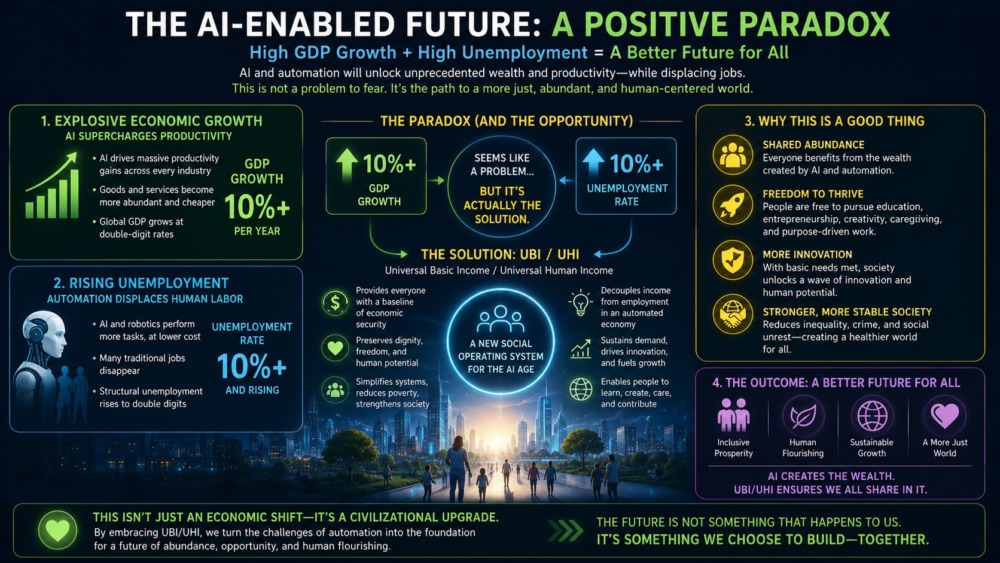
That is not necessarily evidence that AI is bad. It is evidence that our distribution system was built for another technological era.
Artificial intelligence can generate analyses, write software, handle customer inquiries, coordinate workflows and assist with decisions. Robotics brings that intelligence into physical space. And the robot revolution probably won’t arrive as one spectacular moment when a perfect humanoid walks into a factory and replaces everyone.
It will arrive – it IS arriving – through thousands of smaller automations.
A robotic arm performs one task. Meanwhile a mobile platform moves materials. In a whole other place, an AI system schedules production. A human remotely supervises several machines in yet another business while yet another system inspects finished products. All the while AI agents increasingly coordinate inventory and shipping across multiple firms…
Each improvement may appear incremental and isolated. Taken together, however, they reduce the total amount of human labor required to produce the same output. That’s the metric that matters. Not whether a robot looks exactly like us or whether AI can perform every part of a job. The important question is whether the whole system needs fewer human hours.
Increasingly, the answer will be yes.
Fewer Workers Does Not Mean Fewer Valuable People
This is how the AI conversation becomes a spiritual conversation. When a company says it needs fewer workers, many people hear something else. They hear that society needs fewer people. Or that some people no longer have value. That interpretation comes from centuries of conditioning linking worth with productivity.
We praise the “hard worker.” We vilify the “lazy”. In casual settings, we ask people what they do shortly after meeting them. We organize identity around occupations, describe unemployment as being “out of work,” even though unemployed people continue caring for families, solving problems, learning, helping others, creating beauty and being human.
Then we make access to survival depend on securing someone’s permission to work. The result is an arrangement in which a person can be surrounded by abundance yet denied access to it because a corporation has no profitable use for that person’s time. That isn’t just an economic contradiction; it’s a literal distortion of worthiness.
From the Positively Focused perspective, worthiness is inherent. It doesn’t come from effort, employment, productivity or social approval. We don’t earn our right to exist. Nor do we become more valuable by spending more hours performing tasks a machine could eventually perform better.
Human beings are extensions of pure positive energy—eternal consciousness focused into physical experience. We came here to explore, create, experience contrast and turn that contrast into more expansion. We didn’t come here to justify receiving food. The economy’s declining need for human labor exposes the distortion for what it is: distortion.
For centuries, the requirement to work obscured our inherent worthiness. It made survival appear like a reward granted in exchange for effort. AI now is pulling that belief into the light where we finally can look at it. That may be the deeper gift of the spiritually-based, post-labor transition.
AI isn’t taking away human value. It is taking away our ability to convincingly pretend human value comes from labor.
Protect People, Not Jobs
Fearful conversations about AI often focus on protecting jobs. But jobs aren’t the real thing people want protected. What people want is housing. Healthcare. Food. Stability. Dignity. Belonging. Purpose. They want the ability to care for their families and make choices without living in constant financial fear.
Jobs currently provide access to many of those things. So people understandably defend jobs as though jobs themselves were sacred. They aren’t. People are sacred.
This distortion about jobs is why people are sacred. Eliminating the distortion reveals that each person is a sacred being in and of themselves.
If a machine can perform dangerous, exhausting or repetitive work, why should a human being continue doing it merely to preserve the wage attached to the task? Why defend toil when what we really want to defend is the person’s access to life?
The spiritually-aligned response to automation, then, isn’t stopping technology so people remain economically necessary. It is allowing technology to reduce labor while expanding the ways people receive the resulting abundance. That is a very different objective. It shifts the question from: “How do we make sure everyone remains employable?” to: “How do we make sure everyone shares in what our civilization can produce?”
The first question attempts to preserve the past. The second begins designing the future.
Access Is Not Charity
Universal Basic Income naturally appears in this conversation because it offers one direct way of separating income from employment.
A basic income could preserve purchasing power as labor demand declines. It could provide breathing room for people navigating disrupted industries. UBI also could support caregiving, creative work, education, entrepreneurship and forms of contribution the market undervalues. But UBI alone doesn’t answer every question.
If a small number of corporations own the AI systems, robots, data centers, energy infrastructure and intellectual property producing most economic value, a universal payment may leave the deeper concentration of power untouched.
People may receive enough money to purchase necessities while remaining dependent on those controlling production, housing, healthcare and essential infrastructure. That’s why ownership matters.
A spiritually-based, post-labor economy may require some combination of universal income, public AI dividends, sovereign wealth funds, employee ownership, cooperative platforms, universal basic services and updated taxation of capital-intensive production. The International Monetary Fund has similarly argued that AI-era social protection may need to become less dependent on employment status, while tax systems capture more of the economic rents flowing from increasingly valuable capital.
No single policy has established itself as the answer. Nor should we pretend there is settled consensus.
For example, one recent theoretical paper argues that companies may automate more aggressively than is collectively beneficial because each firm has an incentive to lower labor costs, even when widespread displacement eventually weakens consumer demand. Its authors propose an automation tax and argue that UBI alone may not correct that incentive. That is an economic model, not proven fact or final policy guidance. But the paper highlights an important tension: what is rational for one company may become destabilizing when every company does it simultaneously.
A business benefits by reducing payroll. The broader economy suffers if too many consumers lose income. That’s the paradox. And it reveals why providing access isn’t charity. It is necessary economic circulation. More deeply, it is a recognition of shared inheritance.
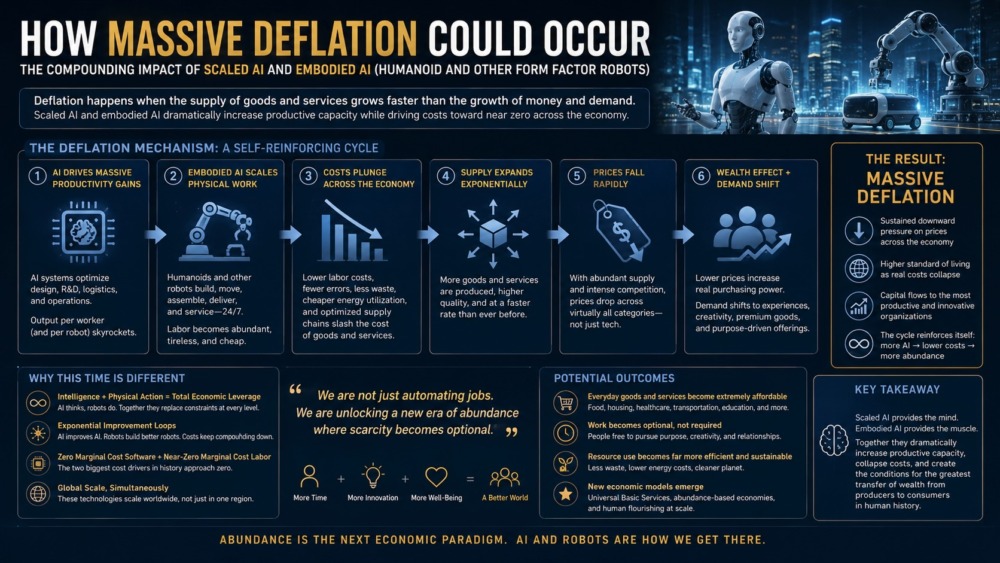
What’s interesting, however, is the paradox also offers promise as illustrated in this infographic below. The AI-enabled future offers unprecedented abundance, extremely low-cost or free goods and services as a result of massive deflation. It’s another eventuality for which we must prepare.
AI didn’t emerge from nowhere. It rests upon publicly funded research, accumulated human knowledge, generations of cultural production, global communication infrastructure and data created by billions of people. Robots likewise depend on centuries of engineering, science, education and collective experimentation. All that rests on a spiritual foundation that makes all of us and the world around us one.
Today’s owners certainly contributed capital, skill and risk. That contribution deserves recognition. But they did not create the foundation alone. Automated productive capacity is the latest expression of a civilization-wide inheritance. Everyone therefore has a legitimate claim upon some portion of the abundance it produces.
The Abundance Already Exists
Scarcity thinking asks how society possibly could afford to support people who aren’t working. That question looks in the wrong direction. The relevant question is what society can produce.
If AI and robotics dramatically increase productive capacity, then the goods, services and infrastructure needed for a good life become easier—not harder—to provide. The machines don’t need salaries, vacations, retirement accounts or eight hours of sleep. Once built and powered, many automated systems can continue producing at extremely low marginal cost.
So the real problem isn’t insufficient production. It is access.
We can imagine warehouses full of goods while people lack purchasing power. Empty homes while people lack money for rent. Abundant food while families cannot afford groceries. Highly capable medical systems while patients remain uninsured.
Those conditions wouldn’t demonstrate genuine scarcity. They would demonstrate a distribution system failing to understand the abundance surrounding it. Physical reality often presents contrast before expansion. The contrast clarifies what we no longer want, which launches new desires and new possibilities. AI-driven displacement represents powerful contrast.
It reveals the cruelty of tying survival to employability. It exposes the fragility of making healthcare dependent on a job. AI-driven displacement shows the folly of concentrating productive power in too few hands. It brings forward questions civilization could avoid while nearly everyone’s labor remained necessary.
That contrast is not evidence that humanity is heading in the wrong direction. It is evidence of expansion underway.
The Real Transition Begins Within
Policy, ownership and distribution all matter. But the spiritually-based, post-labor transition will not be solved only through legislation and economic design. There is an internal transition that must happen too. We must release the belief that rest is laziness, let go of the belief that suffering proves character. We must release the belief that receiving without labor is shameful. And we must release the belief that a person’s income accurately measures that person’s contribution, intelligence or worth.
Those beliefs will not disappear overnight. They are embedded deeply in families, religions, institutions and individual identity. Many people won’t know who they are when their occupation no longer defines them. That uncertainty may feel frightening. But uncertainty is also spacious.
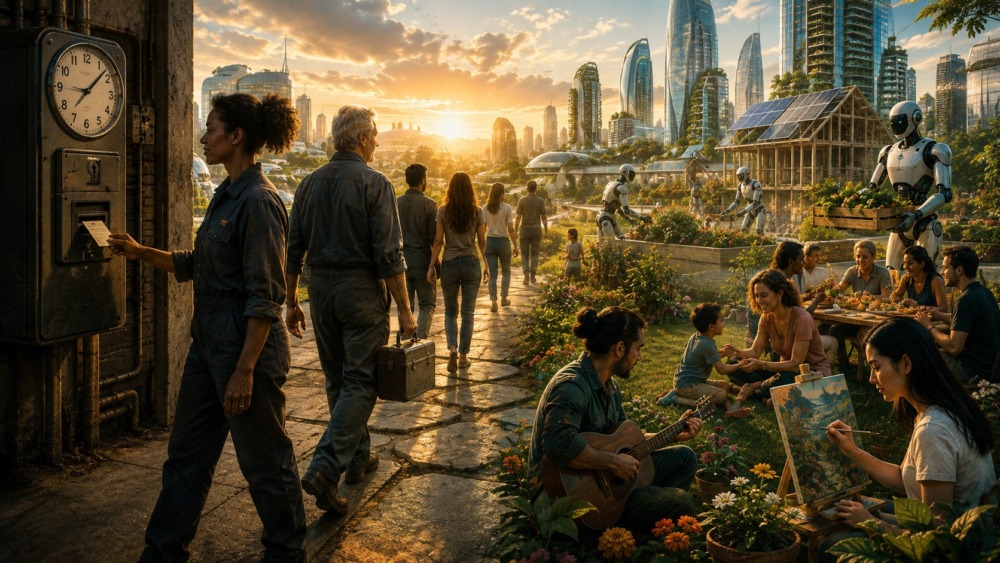
Without compulsory labor organizing nearly every waking hour, people can discover what genuinely calls them. They can care for children and elders. They can make music, restore ecosystems, learn, travel, invent, meditate, build community and develop parts of themselves suppressed by exhaustion.
Some will still choose highly structured work. Others will create businesses or pursue ambitious technical goals. Freedom from compulsory employment doesn’t mean an end to activity. It means the end of activity coerced by survival. That is an extraordinary difference.
We Are Not Becoming Obsolete
The spiritually-based, post-labor economy asks humanity to decide what technology is for. Is it for producing more profit while excluding growing numbers of people from the resulting abundance? Or is it for freeing human beings from work we no longer need them to do?
I believe the second future is already calling us. Thankfully, I see many people leading AI-building enterprises feeling the same way.
We don’t align with that future by denying disruption. Nor do we align by condemning technology, wealthy people or companies experimenting with smaller teams. Opposition keeps attention anchored to the very reality we don’t want. Alignment offers another approach.
We can acknowledge the displacement, support structures that widen access and ownership. People can use AI deliberately. We can let contrast clarify what we want. And we can refuse the false premise that someone becomes less worthy when the labor market no longer needs them.
So when AI performs more of society’s work, let’s not ask what people must do to deserve the output. Let’s ask how the output can free them.
The economy may no longer need everyone’s labor. That doesn’t mean people have lost their purpose. It means employment and purpose finally can separate. It means receiving and worthiness finally can separate. Finally, humanity can begin moving beyond a system that forces people to prove their value before allowing them access to life.
The machines are not making us unnecessary. They are making an old belief unnecessary. And once that belief dissolves, a far more joyful civilization becomes possible.


